Showing posts with label Mahabharata. Show all posts

Palace of Assassins by Aditya Iyengar

As Ashwatthama, the lone survivor of the Kaurava camp, slowly regains consciousness, he realizes, to his horror, that he has been condemned to a life of immortality and leprosy by Krishna, the mastermind behind his opponents’ victory. Burning with hatred for the Pandavas for killing his friend Duryodhana, and stricken
with anger at his own fate, he vows to seek revenge.

When he hears of an infallible gemstone that promises to restore his mortality and cure his leprosy – and allows him to exact vengeance – he is determined to go to any length to acquire it. But he finds himself facing an impossible choice, for his quest could result in the death of the woman he loves.


I had read and reviews Aditya's first book The thirteenth day and I had mentioned that this guy has a knack of spinning very realistic accounts from the mythologies. He has done the same with Ashwatthama this time. The book starts from the day after the war has ended  , the curse placed has taken effect and Ashwatthama lies alone in the desert to deal with his immortality and leprosy. What begins from here is a purely fictional yet quite interesting story of his revenge , love and the a lot of realizations of the aftermath of choices. By all accounts this one is a fast , engaging read with almost no flaws. As a lover of thriller / adventure I relished this one and it was rarely that I felt  I am reading a mythology book. 

Aditya's writing is taut , the story has good pace and twists and the characters well sketched. There is no moment that the story feels dull. I quite enjoyed the monologues that go on in Ashwatthama's head about his past and present , with a certain voice of sarcasm and wit thrown in. It is the kind of story and writing i expected from Aditya based on his first book. 

But this is totally fictional tale that has some refernece from Mahabharata makes it a little hard to love. If one expects the real , researched tale of Ashwatthama, one might be disappointed. If you treat it as just another fictional book , then the lead character needs a bit more flesh. At the end of the book , I had more sympathies with Ashwatthama but could not fully cheer for his victory either.

My Rating : 3.5/5

Buy the book here
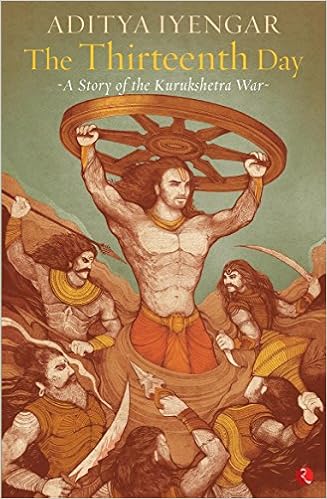
The Thirteenth Day by Aditya Iyenger - A story of the Kurukshetra War

I have probably read almost all books written about Mahabharata war or based on the epic in the last two years. Then It all became so similar that a break was much needed. While everyone has a different view about the events or uses a different character to revolve the story around , the element of mythology or the beyond reach kind of narration stayed in most books. As much one tried to imagine the characters as human without magical powers or means , it was never perfect for me till I read "The thirteenth Day".

This book is funny ,  feels real , interesting ( I mean it ! ) and well written account of the Kurukshetra war , starting from the night of tenth day , after Bhishma has fallen and now lies on a bed of arrows. When Karan visits him later that night , he asks him to take over the throne , he being the eldest Pandava and best friend of Suyodhana. While Karan who is referred as Radheya in the book , is in two minds about this offer , the war intensifies as new strategies are decided each night and the day passes in offense / defense from the battle formations , clash of warriors and the personal agendas of all involved.

I always admire war movies for the details of the planning and the execution of the strategy and the tales of each character involved. Aditya has written this book in almost similar fashion. The book is in voices of the main characters , capturing their feelings and unsaid thoughts. The conversations are easy to follow and often with a tinge of humor. The descriptions of the events and the weapons are realistic and rooted to the economical and practical feasibility in those times.

I absolutely liked reading Yudhishthira's accounts - the person he is , the person he is supposed to be and the clashes of the two personalities.

I returned to reading after a month's break and I could not have had a better one to return to. I am almot sad this ended so soon.

My Rating : 5/5

Ajaya: Epic of the Kaurava Clan Book 1 - Roll of the Dice by Anand Neelakantan


Review by Nimue :

It is said that reading widens your perspective. But that will not happen unless you read all views on the topic. With that in mind , I picked “Ajay”. Initially I could not understand the reason behind the book’s name . Ajay meaning one who can not be defeated , does not suit Kaurava brothers at all. Was it a word play with the “Jaya” , the other name of mahabharat ? This I would like to ask the author some day.
 
It was not easy for me to connect to the book for the fact that I was too accustomed to treat Pandavas as good ones and the Kaurava brother duo of Duryodhan and Dushasan as being the notorious ones right from their bith. How wrong ! How can a child be this evil unless conditioned to be so ?  the transition of Suyodhan and Sushasan to be known by their now popular names is both amusing and little saddening. To imagine the teachers being ignorant enough to curb a child’s curiosity in name of religion and rituals rings a bell to the current scenario where religion is used to preach a lot of senseless stuff. The portrayal of the society in that era and the troubles of the lower castes and the poor bears a parallel to today’s Indian society. no wonder , corruption , crime and rebels were so convincingly used in the plot.
 
100 pages into the book , I kind of appreciated the fact that the author had so carefully and so perfectly turned every character into a human being. No divine powers and miracles were left assumed to be so. Every event and character had a reason and a role to play in the epic we know as Mahabharat – from the well known to the unknown people. Everything was lot more plausible than the Mahabharat based books I have read before , which always had a mythical and mystical air about the story. I liked the dialogues of Bhishma and Balaram about bringing change in the society and to keep trying as they seemed fit , in hope it would make some effect on generations to come. Personally , the meeting between Balaram and Suyodhan was very inspiring read for me.
 
Krishna , who is another very prominent character in this story has been painted in an entirely different light , a bit shocking at times and at others , it fits too beautifully in the plot to be even noticed until the end where I found myself asking , Was Krishna really a God or given that title by humans for their sake. Which reminded me of the part where Balaram says that everyone has god within them.
 
I totally heart this book and wait for the other two parts ( Oh yeah , the book is huge already ! ). This has made me look at the tale with a new pair of glasses and I hope I can get to read other such works this year.


Review by Urmi : 


let this book sit upon my shelf for a long time before I started reading it a couple of weeks ago. It sounded like one of those riding the current mythology wave, and I hadn't heard good things about it from my other reader friends. However, the huge success of Neelakantan's debut book, Asura, and the fact that this was a story of the 'other side', piqued my interest. We've read altogether too many Kaurava-bashing Mahabharatas, and a fresh perspective was welcome.

It is interesting that Neelakantan should pick a name like Ajaya for his trilogy, because to me it seems like a subtle and intentional mockery of the 'original' Mahabharata, which was called Jaya. Incidentally, popular mythology author and illustrator, Devdutt Pattanaik, has also recently wrote a book by that name, which did very well. The word 'Ajaya' means invincible, but phonetically split, A-Jaya also looks like the anti-thesis of Jaya. Neelakantan seems to have decided to be the anti-heroes' torchbearer from the word go, as he subtitles the book Epic of the Kaurava Clan. Roll of the Dice is the first of the three books in this series.

Roll of the Dice takes a little time picking up pace, which might explain the few discouraged readers I spoke about earlier. He takes his time introducing the principal characters like Bhishma, Drona, Kripa, Balarama, Karna, Parshurama, Shakuni, Ekalavya and of course, Suyodhana (Duryodhana) and dedicates entire chapters to them. But once the stage is set, the plot gathers speed and the story flows easily from one chapter to the next. The author paints detailed character sketches, even those of minor characters like Jara, Dhaumya, Takshaka and Mayasura, gently convincing the readers to empathise with the traditional villains. In fact, Neelakantan's excessive sympathy for the underdog translates into large-ish portions dedicated to the untouchable beggar Jara and his blind dog, Dharma. Jara's continued presence in the plot evokes tremendous pathos and keeps reminding the reader that this is the story of the other side, which no one has ever wanted to hear.

Neelakantan is convincing in his portrayal of Suyodhana (nicknamed Duryodhana by the Pandavas) as a kind-hearted if short-tempered soul. Karna, who is generally recognised as a noble character even in the 'regular' Mahabharatas, is shown as a valiant warrior and friend, and Ashwathama & Sushasana (aka Dushasana) as loyal friends and supporters. Only Shakuni is the pure villain in Neelakantan's book. The author also succeeds in painting the Pandavas, Kunti and Krishna in a rather vile light, portraying them as a ruthless and conniving bunch. Only Arjuna's character is shown to have some nobility. He downplays their divinity and offers rational, believable explanations instead. One of my favourites is how he explains Karna's divine Kavach (armour). He says the armour, crafted by the finest workmen, was a gift to Karna by a king belonging to a dynasty of sun worshippers. Sounds so much more plausible than a baby being born with armour, doesn't it?

Even though Neelakantan rationalises a lot of mystical elements in his book, his story remains true to the original. Although sources have not been quoted, the basic plot is the same as the Mahabharata we have all grown up listening to. It seems thoroughly researched and generally legit. Some relationships/connections such as Subhadra and Suyodhana's, Karna and Parshurma's, Takshaka and Ekalavya's may be romaticised and fictionalised, but they serve the author's purpose well in painting these anti-heroes in a humane light. He is, in fact, so skilled as an author, that in just one book, I've found my faith in Krishna a little shaken. If that's not his success as an author, I don't know what else is.
I shall definitely complete the trilogy as they release, and you should too.

Arjuna - Saga of a Pandava Warrior-Prince


Author: Anuja Chandramouli
ISBN-13: 9789381576397
Binding: Paperback
Publishers: Leadstart publications
Copy source: Publishers
Pages: 364
RATING: 2.5/5

Times are bad. Children no longer obey their parents, and everyone is writing a book. ~ Cicero M Tullius

If Cicero was to say this today, he'd have modified that last bit to ...and everyone's writing a book about the Mahabharata. After Ashok Banker, Devdutt Pattanaik and Amish Tripathi, India seems to be mass producing contemporary Indian English authors of mythology. Can’t blame them, really. Our epics are so rich and endless in their inspiration that any wannabe author without an original story turns to them for a reinterpretation, a retelling.

The Mahabharata, in particular, with its myriad characters, is a favourite and stories from the points of view of individual characters are flooding the market. It probably started when Prem Panicker translated Vasudevan Nair's Randaamoozham, a retelling of the Mahabharata by Bheema. Panicker’s book was called Bhimsen. Next was The Palace of Illusions by Chitra Banerjee Divakaruni, which came out in 2008. The last couple of years have seen books like, Mrityunjaya (a story about Karna) by Shivaji Savant, Women of the Mahabharata by Chaturvedi Badrinath and more recently, even Karna’s Wife, the outcaste’s queen by Kavita Kane! There may be many others I’m not aware of, but one of this genre recently landed on my table for a review.

Arjuna – Saga of a Pandava Warrior-Prince by Anuja Chandramouli tells the story of the Mahabharata from the perspective of the most illustrious of the Pandavas. While the book focuses on the important milestones of Arjuna's story, especially his 12-year exile, the story is essentially that of the inexorably connected Pandava brothers. Either it is impossible to separate the five, or the author hasn't done a good job with the single perspective. Because I've not read any of the books mentioned above yet, I do not know how they compare. But if an author decides to pick one character, as a reader, I would expect a more fleshed out one than what Chandramouli has presented here.

The language is also simple to a fault. Its plainness doesn't make the book easy to read; instead it makes it dull. For a tale as amazing as the Mahabharata, it is sad if one doesn't feel like reading more than a few pages at once. For me as a reader, the language neither induced great visuals, nor was there any music in it. I remained impassive to the protagonist and the plot right through the book. The author fails to make Arjuna memorable for me any more than he already is. But the book will serve as a good refresher for anyone looking to brush up their Mahabharata trivia.

While this book was a little bit of a disappointment, I welcome this wave of Indian English books on our greatest epic. The Mahabharata belongs to everyone and its rich lessons ought to stay with us. It is only with such books that the newer generations will take interest in and take forward this fantastic legacy. I certainly look forward to reading many more from this genre of books.


Review: Iliana Xander's 'Love Mom'

  Iliana Xander is making waves globally in the crime fiction genre, and much like Freida Mcfadden and Coolen Hoover (though she is more int...