Showing posts with label Saumya Kulshreshtha. Show all posts

Baker's Dozen - The ELLE Tranquebar Book of Short Stories


I will begin this review with a quote, which has got nothing to do with the book. It is by one of my favourite writers, whose writing style is something I have always tried to learn from.

"People ask me why my style is so simple. It is, in fact, deceptively simple, for no two sentences are alike. It is clarity I am trying to attain, not simplicity. Of course, some people want literature to be difficult and there are writers who like to make their readers toil and sweat. They hope to be taken more seriously that way. I have always tried to achieve prose that is easy and conversational. And those who think its simple should try it for themselves." - Ruskin Bond

In my entire journey with Baker's Dozen, this fond quotation was ringing in my head. Not because I wasn't enjoying what I was reading, but because I was applying a lot of my brains into understanding thoughts which I would much rather flow with. Writing in a fashion which is complicated and extravagant is perhaps the order of the day, and it carries with it streaks of brilliance too, but it is not something which gives you the comfort of book you may snuggle in the bed with. This, I am saying despite having enjoyed the ELLE Tranquebar book of short stories thoroughly.


Baker's Dozen is the kind of book which enchants you from the time you receive it in your hand. The minimal art-work on the cover, and the thought behind the title are the first things you marvel at, and the ride promises to get better. Contrary to what one might expect, it is not a collection of 12 tales, rather, it has 13 hand-picked short stories - the 13th thrown in for good luck, just like bakers traditionally would do with a loaf of bread. The stories come divided into two sections - one by ELLE and the other by Tranquebar- and both sections have stories which are gem-like in their sparkle. I remember being a little harried with the plot of the first story, only to become a big fan of the author,Sharanya Manivannan later. Her story, Greed and the Gandhi Quartet is nothing like what you might have ever read in the name of short fiction, ever. Her narrative is in the form of a conversation, leading to a richer storyline at the backdrop of it all. Something to learn, something to simply be impressed by, something also to connect with.

The story which falls second on the list of my favourites from this book is The Howling Waves of Tranquebarby Madhulika Liddle. It is a story whose end did not surprise - but the craftiness and imagination of the author deserve a full score. Set in an eerie locale, this story takes the reader from shivers to amusement - and it one of the most amazing examples of good and effective story telling.

Baani and Salted Cashews, by Payal Mukherjee and Divya Sreedharan respectively, take up compelling social issues and create a hard-hitting narrative about them. Salted Cashews tells you about the kind of perversion which exists in our society at a subterranean level, capable of and successful in robbing of the innocence and gaiety of childhood. Baani takes one to the world of refugees, their struggles with life on a daily basis. You will find other stories in this anthology throwing light on various facets of existence, including love, including sexual advances at workplaces, including dreams and desires, and so much more.

To state in a single sentence - this is a thoroughly enjoyable book, a collectible, where no two stories are alike, where you need breathing space while hopping from one tale to the next and where, you will end up being enamoured by the kind of writing talent which exists in India. My only problem with the book is its often cryptic, high-flown language. I will admit, I tried hard but could not complete Mridula Koshy's stories at the end. I am the kind who stubbornly pursues even a very boring novel just for the satisfaction of having finished it. And these were short stories I abandoned. They might be stylistically brilliant, but they do little to prove that good literature is the one which needs to be embellished with incomprehensible narration. Literature is supposed to reach out, to touch, to perhaps also reform - a little simplicity in telling a tale in what I would earnestly hope for in future stories which come my way.

It could've easily been a 4+ star book for me, but just for the amount it made me toil, I think I would settle with 3.5 on 5 stars.


Book Details -
Author - Various authors
Publisher - Tranquebar/Westland
Published - 2013
Book Source - Review Copy
Genre - Short-fiction/Anthology 
Price - Rs. 250
Pages -  192

The City of Devi by Manil Suri

I was overjoyed to receive my first overseas mail carrying a book for review by Norton publishers. So far, I was aware of this publishing house's name for the critical content it printed on literary classics, and was pleasantly surprised to see Norton publishing contemporary authors with experimental narratives and genres. Taking up with novel with a slightly odd name - "The City of Devi" - was easy, since credibility was established by the very name and packaging of the courier I received. That Manil Suriwas a writer who could churn out an epic with an apocalyptal theme turned out to be a pleasant surprise waiting to be unfurled with the turning of pages of this book.


The City of Devi is an innovative, unique and adventurous novel. It dwells on a love triangle with a twist. There is a woman, and two men. However, contrary to what you might be already thinking, in this book, a woman, Sarita, and a man, Jazz, are both madly in love with a third person, a man -Karun - who is the mysterious, elusive figure in the book. It is Karun, however, who keep the two alternate strands of narrative, that of Sarita and Jazz, find a common ground to develop cohesively from. The rather tumultuous love saga of these three protagonists is set against the backdrop of an apocalypse waiting to happen - a nuclear strike on Mumbai, ready to wipe out the last trace of life from the island. In a classic tale of cross-border communal conflict, humanity is standing vulnerable and on the verge of being sacrificed for what are assumed to be conflicts of supremacy of divine powers. Mumbai only could be saved by its patron Goddess - Mumba Devi, recently resurrected in a Bollywood incarnation - Super Devi - giving more fillip to the blind adoration of gullible multitudes. And amid all this mayhem, two, no three, lovers are eagerly searching for an opportunity to unite with each other, after eliminating the 'other'.

This novel doggedly follows the quest motif - a rather effective one in stories which deal with the pains and ecstasies of love. Love is, it goes without saying, the underlying theme. In addition to it, theme of communalism, humanism, hypocrisy, apocalypse and homosexuality have been adequately dealt with in the book. With sensibility and gusto. Dystopia, towards which the real world too is fast spiralling, is another prominent theme. The novel is rich with explicit content, and for the shy readers out there, I have to mention, Manil Suri does not believe in using innuendoes. A powerful strain of narrative, in fact, is developed around a pomegranate - a perceived aphrodisiac (about the veracity of which claim I have no clue!), and that pomegranate continues to be an inanimate, silent yet pivotal character in the book. Manil Suri also weaves together myths and memories in the story; especially curious is the way he deals with a rare interpretation of the concept of divine trinity.

The City of Devi is a work of passion, and intelligent story telling. It has elements which enthral a reader and keep drawing him deeper and deeper in the fiction which starts assuming dimensions of reality. An intriguing beginning and an out-of-the-box climax add perfection to an already great scripting. A grand cast of characters does not obfuscate a reader, because the main concern - the protagonists - are so well constructed and foregrounded. Witty dialogues and great use of embellished language make the reading experience rich and satisfying. Love and romance always work for the audience; but when supplanted with an element of impending doom, they acquire a texture of passion and urgency - a fact aptly exploited by the author. I could go on writing reams of material on they way this book influenced me, but for now, I will conclude by awarding it, in all humility, 4 stars on five. It is one great adventure to be a part of.


Book Details -
Author - Manil Suri 
Publisher - Norton
Published - 2013
Book Source - Review Copy
Genre - Fiction/Romance/Dystopia
Price - Rs. 499
Pages -  400

Reviewed by - SAUMYA KULSHRESHTHA

45 Days In A Cancer Hospital by Alka Dimri Saklani


I am eating, living, breathing mysteries. Yes. In books. On television. In my mind too. Its just a matter of time before I become that lampooning character who roams around the world casting suspicious looks at people, trying to find mysterious stories and explanations where exist none. Phew. One more time, its a mystery that came my way for review. A win - its a different kind of mystery - a medical mystery - the first that I have ever read.

45 Days In A Cancer Hospital is the debut work of author Alka Dimri Saklani. This book narrates a story based in Umeed Hospital - a medical centre which has built its reputation as the best cancer treatment centre, in perhaps the whole country. Dr. Chatterjee, the founder of this hospital, is also a famous cancer specialist, one known to have given his life to the cause of caring for cancer patients. His own mother had died of bone cancer and under excruciatingly bad conditions since his father refused to afford the treatment. His incapacity to save his mother as a child drove him towards the noble medical profession - one which he pursued with obsessive sincerity.

Enter Ashritha - a young and famous writer, who, as her latest project is writing a book on the lives of cancer patients, for the purpose of which, she decides to stay in Umeed Hospital and observe and interview patients. She hopes that her book will become a source of hope, company and inspiration for others afflicted with this deadly disease. However, little does she know that the hospital she chooses to stay in has more to offer than just the stories of people coping up with cancer. A number of terminally ill patients are being killed in cold blood - an extremely strange occurrence given that they are already going to die. Ashritha, the strong, concerned and smart woman she is, suspects some foul play and with the help of her friend from CBI - Animesh - gets on course to unravelling the elusive facts behind these hideous acts. The road to solving the mystery is paved with threats to Ashritha's life, but for once does she not buckle down. If anything, she is even firmly back on the case. Intellectually ripe, she is able to figure out it all - only her wildest dreams could not have conjured where ultimately her investigations lead her. This, along with a subtle, brewing romance between Ashritha and Animesh is what makes this book a wholesome tale to savour.

I roughly took three days to finish this book, that too when I had a pile load of work to do. The previous line is to show that the book managed to keep me engrossed. The storyline is interesting, with adequate crests and very less troughs. Crises are introduced in the story when you least expect. However, as you get friendly with the author and the psyche of her characters, for sometime, the narrative does become predictable. The tale ends like most mysteries do - the culprit is not whom you expect, but one who fits the jigsaw perfectly. Alka's characters are deep, and have consistent traits, which makes them easy to understand and follow. The language of the book is quite ordinary and comfortable. No big promises, but this book does live up to the excitement it creates in the back-cover blurb. The knowledge and research of the author shows in the way she has described unto last detail the life of doctors and nurses in the hospital. The book seldom loses its focus and ties together all the lose ends at the climax. To summarize, I would not label this an extraordinary piece of writing, but a genuinely decent effort by first time writer Alka Dimri Saklani. Giving it 2.5 stars on 5, I would go on to say that this is the kind of easy-read mystery that would conveniently fit into your hectic schedule and provide welcome distractions.


PS - My favourite bit about the book is the Acknowledgements. The author admits to having named her protagonist on her brother, because his support during the process of drafting the book was invaluable. I only hope that if someday I get down to writing a book, I have similar support systems available to me too. 

Book Details -
Title - 45 Days In A Cancer Hospital
Author - Alka Dimri Saklani
Publisher - Leadstart
Genre - Medical Mystery / Crime Fiction
Price - ₹ 195
Pages - 296

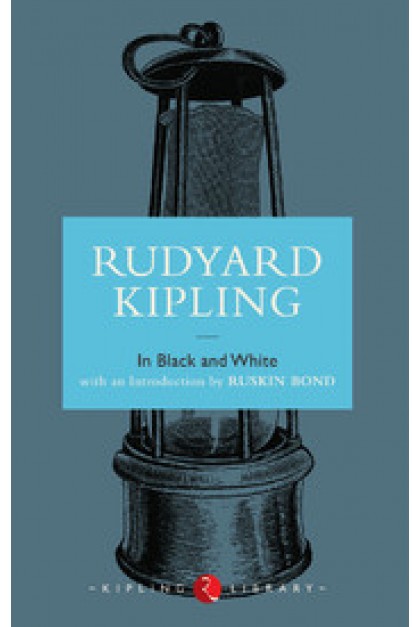
In Black and White by Rudyard Kipling


He was the youngest recipient of Nobel Prize in Literature, the first writer of English language to have that honour conferred on him. My inspiration in writing, Ruskin Bond, found inspiration in his writing. And if I had one regret emanating from the world of literature (which I know is vast and perhaps has no place for regrets), it was that I never got an opportunity to read any work of the great storyteller Rudyard Kipling. However, in a recent set of book Rupa Publications sent me for review, I got my chance to overcome that regret.

In Black and White is my first tryst with Rudyard Kipling, and what a grand, memorable meeting with the master-storyteller it has been. Kipling has been regarded as an innovator in the art of short story writing, and this book is only one of the many examples which lends credibility to that statement. In Black and White is a collection of some of Kipling's finest stories which shed light on the social, cultural and political fabric of India, as it was woven under colonial rule. The imperial conquest of power etched a firm, and almost cruel boundary between the ruler and the ruled - a reality which stories of this book bring out vividly. The language, I will have to admit, was not the easiest to understand. In fact, if anything, it was most abstract, but that is what gave space for philosophical ideas to run parallel to the main narrative of extremely engaging stories. A miner, a priest, a missionary, a betrayed and revenge seeking lover - each character has been drawn deep from within the womb of humble Indian terrain and represent in full the idiosyncrasies of Indians. The tales are endearing at times, witty at others, and scathingly ironical at certain places. Kipling presents both - the inherent innocence of Indians and the corruption which started taking roots under the reign of the Raj in these 8 short stories

The Whole Range of Kipling Special Books 
It is a small book, priced humbly, to invite readers to the enamouring, but critical world of Kipling. My favorite among all is a story called "Dray Wara Yow Dee". Don't ask me what that means. I just know I enjoyed this tale of a lover betrayed, seething with revenge. For the first time, it was not poetry, but prose in which I found an unmistakable lyrical quality.

Kipling has a controversial place in History. He is credited with a doctrine which not just justifies, but glorifies imperial conquests. Given his philosophy of 'A White Man's Burden', I have always wondered how is it that Kipling wrote of nothing but India and its people, so much so, that many literary connoisseurs bracket him in the Indian Writing in English category. A man, not wedded to the sensibilities of this magnificent land could not have possibly written literature which seems like our own. Perhaps this dichotomy in Kipling's writing is best understood in the words of one of my English teachers, who warns with affection - History often doesn't give us the chance to alter our opinions, we must learn to be careful with them.

Its a 3.5 on 5 star book for me.

Book Details - 
Author - Rudyard Kipling (With an introduction by Ruskin Bond)
Source - Review Copy
Genre - Literary Fiction/Short Fiction
Publisher - Rupa Publications
Price - ₹ 140
Pages - 118 (8 stories)
Rating - 3.5/5

The Sari Shop Widow by Shobhan Bantwal

Indian Mills and Boon anyone? Well, here is one! And what a grand book to lift my spirits.


The Sari Shop Widow is the quintessential romance, with desi twist in a foreign land. It is the story of anAnjali Kapadia, leading a widowed life since ten years. She is a designer, and runs a tasteful boutique in New Jersey. She is married to her work, but complications enter her life when her business faces troubled waters and her dreams stand jeopardized. Problems intensify further when Anjali's father calls over his elder brother -Jeevan - to save her troubled business, the only problem being his brother's reputation as a dictatorial, shrewd and ruthless businessman. The series of shocks doesn't end here. Jeevan brings with himself a suave, dapper, half-British business partner - Rishi Shah - in the form of a business consultant to resuscitate Anjali's drowning boat. However, Rishi Shah enters Anjali's life as something more than just a business consultant. He revives that corner of Anjali's heart which had been purposely locked away to avoid pains of getting hurt over love. She is aware of his intense gazes, but she does not trust him. If anything, she hates him for having come suddenly into her perfect little world, and turning it upside down. She hates the fact that Rishi Shah will take away from her the only thing she had built since her husband's death - her boutique, her work.

In this atmosphere of extreme hostility begins their story. She hates him, distrusts him, but is aware of the tremors which stir her body when he comes near her. Rishi, on his part is smitten with Anjali, but has a tough exterior - steel in his eyes - which keeps his tenderness hidden from her. To make matters worse, Rishi has a girlfriend back home, with whom he has shared half a decade of his life. How does the notion of romance even enter the picture then? Well, I was left wondering too. But there is a reason why over 1,00,000 copies of this book have been sold. The reason is author Shobhan Bantwal's extremely engaging and sensitively developed narrative. Take my word  for it, she is an author under the effect of whose pen, you as a reader are absolutely secure. By the end you realize that investing your heart and emotions in this story was absolutely worth it.

I have a weakness for love stories which have an element of forbidden in them - something which doggedly opposes the consummation of true love. The Sari Shop Widow is a rather modern, easy going story for very long, but at the point where emotions raise their head, I had to stop and catch my breath. Anjali and Rishi are characters who come alive with force. You feel for them at each twist and turn in the story. You take sides. You pray for them. You just hope they come together with fierceness. That is what an intense love story should do to you. That is precisely what this book does to you.

The Sari Shop Widow was a wonderful read through and through. I have no qualms, not one, with this lovely romantic tale, and this hasn't happened in a long time. There are sub plots, stories running in the background, a subtle mysterious touch, and absolutely no loose ends. The author maintains a cool control over her narrative. You flow, and gladly so. The descriptions in the book are not run-of-the-mill. At times, all romances seem alike in texture. However, this book might lend that slight touch of freshness that the romance genre so badly requires. A widow. A middle aged businessman. Their encounter in the most adverse circumstances. Inevitable romance. Order this book, prepare a cup of coffee when it arrives, tuck into your quilt - and savour some smouldering romance to beat the winters. Its a 4 star book for me!


Book Details - 
Author - Shobhan Bantwal
Book Source - Review Copy
Publisher - Fingerprint
Published - 2012
Genre - Romance
Price - ₹ 250
Pages - 361
Rating - 4/5

Lost Libido and other gulp fiction by Salil Desai

I have no idea what gulp fiction means. Is is the kind of fiction which is so awesome that it makes you gulp? Or makes you choke with excitement? Or makes your heart stop momentarily under the thrill it creates? Whatever it is, it is a potentially amazing, rather, fatally amazing genre of fiction to experiment with. And Salil Desai, in his third book, has done a marvellous job of introducing and promoting this new and curious genre of writing in the market.

I am still gasping from the effect the second last story of this compendium - called Lost Libido and other Gulp Fiction - had on me. I could talk about that one story at length, and of course, Cul-De-Sac, the name of the story I am caught under the spell of, happens to be my favorite of the lot. It is funny, innovative, creative, weird, weirder  and just so exhaustively awesome, that despite being one of the longest of this 17 story collection, I still wished it wouldn't end. I wanted it to give me more moments of hilarity. I wanted to see to what level the author's imagination could stretch. And stretch it sure can. Not so much imagination as wit and observation. Salil Desai, in this collection of short stories drawn from mundane lives of urban individuals has proven himself to be a master of both - wit, observation - and perhaps a lot more. 


Lost Libido and other gulp fiction is a book which single mindedly sets out to dwell on the darker side of humans. When Angel Lucifer was expelled from Heaven and given the unholy title of Satan, he vowed to keep extracting revenge from the most dear creation of God - Man. And he did not stop at the exit gate of Garden of Eden. He followed Man to Earth, and is almost as important an influence in Man's daily activities as God, or Goodness is. Only we seek to refute this obvious fact time and again. Salil Desai's book will not paint any heavenly pictures of human existence. It will not tell you how beautiful life is, how goodness always triumphs, how truth is consistent, or how love is the basis of existence. It will show you a mirror of your lives, our lives. It will tell you how an average individual, caught in the rigmarole of routine jobs copes up with stress which his confused existence heaps on him. People today, specifically talking of India (since this book uses urban India as a backdrop), are dealing with a life which is always in flux, where competition lurks in ugly manifestations and where desires and expectations often get the better of man. If anything, Salil Desai's book will break the image of a perfect world which you conjure, very specifically in a story interestingly titled - Our Friendly Neighbourhood Murder.

Each story, which finds a place for itself in this anthology, is worth talking about individually. Very few, if any, disappoint the reader. The only reason I had of being disappointed with a few stories was that with the first two stories, Salil establishes a high standard from himself - one that as a reader you fervently hope doesn't dip at any cost. I have said this before, and I maintain - In the mad pace of life all of us have adopted for running towards nothingness with, short stories are ideal breaks one can afford to apply when distractions are sought. Only, be careful of reading a book with as promiscuous a title as "Lost Libido" in public transport. Like I did on my daily journeys in metro. People stare. But that is also fun in a way.

So, anyway, this is a 3.5 on 5 stars book for me. My favorite of the lot were - 
1. Cul-De-Sac - Enough reasons explained above.
2. The Maths Conundrum - As a child, I had a horrendous time trying to cope up with the devil that mathematics was. I understood what little Nakul went through while being unable to cope up with the same, though I had no idea his predicament would acquire such tragic proportions. 
3. Our Friendly Neighbourhood Murder - Dark. Awesome. Brilliant. Leaves you asking for more. 
4. One Monday Morning - A whole family, spending its last happy day together. Why last? Well, read to find out. I only wish the ending gave me more. 
5. A Susceptible Conscience - This story is one in which all of us, invariably, will find an echo of ourselves in. How easily we convince ourselves, how easily we think we deceive the omnipresent powers - read this one to know. 

Book Details - 
Source - Review copy
Publisher - Fingerprint
Published - 2012
Price - ₹ 195
Pages - 288
Genre - Short fiction
Rating - 3.5/5

When The Snow Melts by Vinod Joseph

My library has seen a flood of thrillers/crime novels finding their way in and stuffing themselves on every last inch of space available on any shelf. The latest entry, sigh, belongs to the same genre. However, a saving grace of all these books have been, that they have taken me through different terrains, different sub genres of thriller-writing. While the last thriller I reviewed was a medical mystery, and the book I am reviewing for this post had the promise of being an exciting spy novel - and exciting is only an understatement for what Vinod Joseph's book, 'When The Snow Melts' turned out to be.

It is easy to give views on a piece of writing when as a reader, you are friendly with the subject matter contained there in. However, my knowledge of spy-activities and intelligence sharing is limited to Bond movies and Ludlum novels - which is a fair knowledge, I feel. However, no novel have I read which explores fictional topographies constructed out of intelligence activities carried out by Indian or Pakistans spies. Yes, I have seen Ek Tha Tiger, but please - stop! To even mention that overtly (ridiculously) romanticized tale in the review of When The Snow Melts is to do injustice to the great fun and thrill I experienced while reading this novel. In long, I came across a book which I just HAD to finish in one reading. Two readings, spread over 2 days, is what it eventually took. I would not say it is the greatest spy-fiction ever written by an Indian, the novel does have its lackadaisical moments, but overall, I can already let it out - this review will sing strong praises of the author Vinod Joseph.

A little about the storyline before that. Ritwik Kumaris a veteran intelligence agent, who is working with Intelligence Assessment Group in London - a global terror fighting establishment where intelligence reports from across frontiers are pooled in to make the combat against terror outfits more cohesive and efficient. However, Ritwik is not quite the quintessential, invincible, extremely smart spy, who is all committed to the task of searching out Osama Bin Laden from his hideout in the hills of Afghanistan (well, that is what it was assumed for a long time, isn't it?) or purging the ISI, and the whole world, from fanatics and fundamentalists promoting violence in the name of religion. Ritwik is an alcoholic and gambler, snowed under debt, who defects over to nothing less than the al Qaeda! And from their begins the tale of finding his place in the midst of their ideological impositions, feeling titillations of a possible but forbidden love and saving not only himself, but his love interest from the way of fatal harm.

Honestly, the reader will be quite clear after reading the first fifty pages what the eventual outcome of Ritwik's adventures in Al Qaeda-land will be, but the journey is truly worthwile. Vinod Joseph's novel is a treat for readers who like to get into the author's mind and attempt to stay a pace ahead of his narrative. A wee bit unfortunate is the fact that as a reader, I did win this race against the author many a times, but there were moments of unexpected revelations, which kept me on the edge and even made me shiver for a nanosecond perhaps. The glimpse that one gets into the world of diplomacy, intelligence-sharing, terrorists and fanatics in this book is quiet valuable. What is excellent is also the fact that the sub-plot of a love story is cleverly woven into the larger script, and not once does it overpower the actual genre-allegiance  of this book - When The Snow Melts remains an interesting spy thriller, giving you something to chew on till the last page. Easy and intelligent use of language make the reading experience better.

I did wonder, at the end, what relevance did the title have to the story line, except for that there was a lot of snow was present everywhere in the description. A title always gives the promise of meaning, and if, in that case, melting of snow is similar to clearing of mist, then, well, okay. There were a few breathtaking turns at the end in the story, but I would maintain, the larger picture was devoid of any mist. On that note, I would conclude this review, by awarding it 3 on 5 stars. Good read, and strongly recommended to everyone who likes this genre

Book title - When The Snow Melts
Author - Vinod Joseph
Source - Review copy provided by the author
Publisher - Amaryllis

Year of Publication - 2012
Genre - Thriller/Spy Fictionn
Price - Rs. 195
Pages - 202

Review: Iliana Xander's 'Love Mom'

  Iliana Xander is making waves globally in the crime fiction genre, and much like Freida Mcfadden and Coolen Hoover (though she is more int...