Showing posts with label Ashok Banker. Show all posts

#CoverReveal AWAKEN by Ashok Banker

THE SHAKTI TRILOGY BOOK I


Gods of war was the first book I read by Ashok Banker. That time I was not even aware of the fantasy / mythology genre. I loved the boom a lot and since ,I have not missed any of the paperback that came out. I also have the subscription tonsite that am yet to use ( Must check if it's still working)


The Haters are coming to destroy all life on Earth. It is not a question of if, but when. 

The Brahmaand has already rung the warning bell and the awakening of the Preservers has begun.


First in the thrilling Shakti Trilogy set in contemporary India, Ashok Banker’s action-packed and brilliantly imagined Awaken introduces our unlikely heroes who must discover and harness their superpowers before they can protect and preserve the Earth from the wrath of a menacing alien invasion.

Ashok Banker is the internationally acclaimed author of over sixty published books which have sold over three million copies in twenty-one languages and sixty-one countries. He has been credited as the pioneer of Indian crime fiction in English and with launching the genre of mythological retellings, India’s biggest-selling publishing category.

Awaken is the first book in the Shakti Trilogy.  The Shakti Trilogy continues with Book II ASSEMBLE (November 2017) and Book III ARISE (January 2018).


  Pre-order your copy here 

The Valmiki Syndrome by Ashok Banker


Author: Ashok Banker
Publisher: Random House, India
ISBN: 978-8-184-00141-9
Binding: Paperback
Pages: 278
Genre: Self-help
Rating: 2.5/5


I have to begin with my admission of having a hate-love (more hate than love) relationship with this author. Despite my ordeal with his Ramayana series, which is also something I’m currently reading, I chose to read The Valmiki Syndrome. Why? Partly, because I was ensnared by the title, and partly, because Random House asked me to review it. And at the end of the book, my perception of the author remains the same. However, the book wasn’t as bad as some other ‘preachy’ ones I’ve read; mostly because it uses mini stories to prove the point. Ashok Banker extols the value, and demonstrates the ancient technique of, katha (storytelling) as a way of gaining insight, knowledge and subsequently, wisdom in this book.

The book talks about The Valmiki Syndrome – the common human conundrum of trying to find the work-life balance. I’m not sure if a concept like this existed, or has been conjured up by the author. I think it is the latter. While using Sage Valmiki’s story as an example was okay, calling the whole problem of work-life balance ‘The Valmiki Syndrome’ was stretching it. The book could easily have been called something like ‘The Work-Life Question’, ‘The Urban Dilemma’ or something else that sounds self-help-ey. But Banker’s love of Ramayana and a clever marketing ploy may have prompted this title. There is a resurgence of interest in Indian mythology in the current generation, and like it tricked me to pick up the book, it will many others.

As I’ve mentioned above, the book has three mini stories about three very different lives. There is an extremely ambitious Suhasini; there is Sara, who rebels to find success in a field not approved of by her family; and there is the dreaded dacoit Ratnakaran, who kills and steals to make a living. The consequences of their chosen paths are very different – Suhasini, on a career overdrive, loses her husband and children; Sara succeeds on her path despite the initial estrangement from her family and goes on to get the best of both worlds; and Ratnakaran realizes, with the help of Rishi Narada, that his family does not really support his means, and goes on to mend his ways by treading the spiritual path.

Through the stories, the author tries to encourage the reader to ask oneself three fundamental questions about identity and life. Who am I? Who do I wish to be? How do I become that person? Once a person mulls upon and is able to answer these questions, he is able to find his life path. He is able to prioritise, act upon, and change his life situation for the better. These are pertinent philosophical questions and I liked the book for them. The author is able to demonstrate simply and easily their importance. The packaging of this ancient wisdom is clever.

My only misgiving, as with all of Banker’s books, is his style of writing. I find it boring, especially in parts where it is Banker speaking. As long as he has his story voice on, where the characters talk, he is tolerable. But when his own opinions come across, he begins to sound ‘bleh’. It’s like ‘I’m not preaching, but do this…’, ‘I’m not being a guru, but do that…’. Yeah, okay, Mister Banker, you’re not trying to preach, but you are. Don’t.


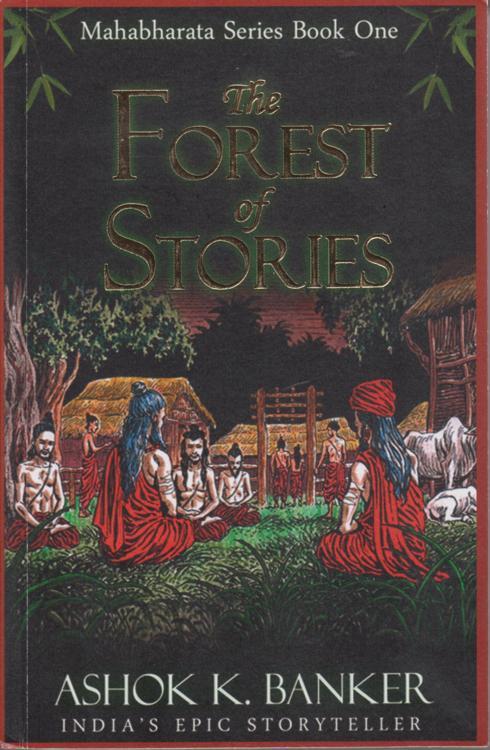
the forest of stories (MBA#1) by Ashok Banker


The Forest of Stories, Book One in Ashok Banker's long-awaited 'MBA' Series, takes us deep into the haunted jungle of Naimishavan. Here, at the ashram of Kulapati Shaunaka, a dustry traveller arrives with sad tidings: Maharishi Krishna Dweipayana Vyasa has passed on. Yet the great collator of the Vedas has left behind a fabulous legacy, the epic narrative poem called Maha Bharata. At the urging of the ashramites, the traveller Suta begins to recite the great composition, starting with the incredible creation myths and tales of god and giants, snake-mothers and gargantuan eagles. And as the night wears on and the tale grows darker, he senses the presence of countless ghostly beings in the shadows beyond the flickering oil-lamps, the restless souls of the many millions butchered in the climactic war that ended the great tale itself, gathering now to hear the epic saga that led eventually to their destruction and the decimation of the Kuru Bharata race


My interest in Mahabharata as a source of stories , wisdom and a sketch of society at any time began with reading 'Palace of Illusion" . A bit of the side events and tales were covered in "the Pregnant King' . and thus began a search for more books on Mahabharata. I had heard and read here too a lot about Banker's Ramayan series so when I saw this book at a friend's place , I could not resist borrowing. 

I had always wondered , why Mahabharata came to happen ? Most religious tales have a straight forward plot ans limited characters. This epic though is completely opposite or say different from any thing I ever heard of. And Banker proves it all the more here. From the very birth of any one remotely appearing or related to the tale has been mentioned and always with an interesting life history of him/her. Its amusing how even the dead or their words pave way to the future - this war of right and wrong. 

There is so much of magic woven in each tale - a moral , a beginning of the end , an end of some other story. Curses are boons in disguise , Devas take different forms and means to help mother earth , the asuras trying to have amrit , meditations and prayers to fulfill desires ,   promises to protect and help , tales of betrayal and love , of mothers and son , of heaven and hell , of trapped souls , of means of salvation , of places and importance , of lost , of preserved history. This book is no fiction my dear friends. Its a beautifully penned research work by Banker.

the narration is fast , the stories enchanting and the feeling so great to be reading of our rich mythology. This book makes you relish the very human - like traits of every one written about. The story-teller in the book has d destiny to narrate this epic to both living and dead alike. Ashok Banker looks like that story teller. He has woven the tapestry of our lives living off the older one. Of a war that marked the beginning of kalayug . Of friends and foes . of discipline , restraint and punishments.


you would not have heard many of these stories, and if you have , are you really sure why or how of it ?

Its time we discovered our roots

Enter the chakravyuh of the tales and hope they deliver you peace and pleasure both.


:)


Rating : 5/5

Other details :

ISBN:  9381626375
ISBN-13:  9789381626375  ,  978-9381626375
Binding: Paperback
Number of Pages: 376
Price : 220


PS : E books are available on Ashok banker's site for next part too. Or on amazon kindle.

Siege of Mithila – Book two of The Ramayana


Author: Ashok Banker
ISBN-13: 9780143033349, 978-0143033349
Publisher: Penguin India
Binding: Paperback
Pages: 552

As long as this book lasted, I was reminded of one trashy pseudo-mythological serial I used to watch with great enthusiasm as a child. Remember ‘Chandrakanta’? Yes, that exact same one with the exaggerated characters with exaggerated eyebrows. My mother groaned and groaned about how utterly tasteless it was, and I agreed and continued to watch. Weekend after weekend, I watched. There was no way I could tear myself away from the display of magic, shape-shifting characters, super drama, and that ultimate hook of ‘What happens next?’


The ‘Siege of Mithila’, like ‘Chandrakanta’, seemed to be excessive at all times. Banker seems to have gone on an overdrive with the second part, in words and their content, making it the second fattest book of the series with 522 pages. There’s so much happening on every page, it’s almost vulgar. Even the writing is so adjective-ridden, that one sentence feels like a mouth so stuffed you cannot chew or swallow. Sample this:Around noon, they had left behind the rolling grassy plains where wild horses, elephant and rhino roamed freely and entire clans of lumbering hippopotami rolled cumbrously in mud pools, and the path had begun undulating constantly, seemingly unable to stay flat any longer, while thickets of wildbrush, sage, bamboo and bizarre profusions of multi-hued wildflowers bounded on either side. My editor hands have wanted to slash in half almost every sentence in this book. There might be readers who appreciate this style of writing and call it giving attention to detail, but I find it onerous. Why, even the first mention of the ‘Siege’ part of the ‘Siege of Mithila’ happens after 300 pages!

Another disproportionate element are the many, oh so many episodes involving sorcery and magic. Because I’ve not read any other version of The Ramayana, I don’t know if they’re part of the original or fanciful creations of the author. While I love and encourage different interpretations of old tales, I’ve found too many things in this book gaudy. Women turning into snakes, people running through magical corridors, men going underwater for missions… you get my drift. Perhaps I’ve read too many ‘realistic’ versions of epics like ‘Yuganta’ and have lost the taste for such work.

But did I stop reading? No. Could I stop reading? No. Why? Because Banker knows how to hold his reader’s attention. And even though I point fingers at the lack of refinement, I must give hand him merit as a writer. It’s like commercial cinema – flashy, given to hyperboles, silly even, but entertaining. Very, very entertaining. Banker makes for a very successful thriller writer, and never lets his pace flag. So long winded as it may seem, you willingly accompany the entourage of Brahmarishi Vishwamitra, the princes Rama and Lakshman, their senapati Bejoo, and an incognito Sita & her bodyguard into the woods and under the oceans, fighting beasts, dacoits and demons and into Mithila for an impending Asura invasion. Parallely thrown in is action from the demon-worshiping Manthara and Dasaratha’s queens in the Ayodhyan palace. Oh, and not to forget a swayamvara and the grand culmination in, guess what, a sorcerous episode.

Am I going to read book three? Yes; because I sure as hell want to know ‘What happens next?’

Rating: 3/5

------------------------------------------------------------------------------------------------------------------------------------------------------------------------

This is part two of the seven-part series review of The Ramayana by Ashok Banker. Read the review of Book one of The Ramayana - Prince of Ayodhya here.


Review: Iliana Xander's 'Love Mom'

  Iliana Xander is making waves globally in the crime fiction genre, and much like Freida Mcfadden and Coolen Hoover (though she is more int...